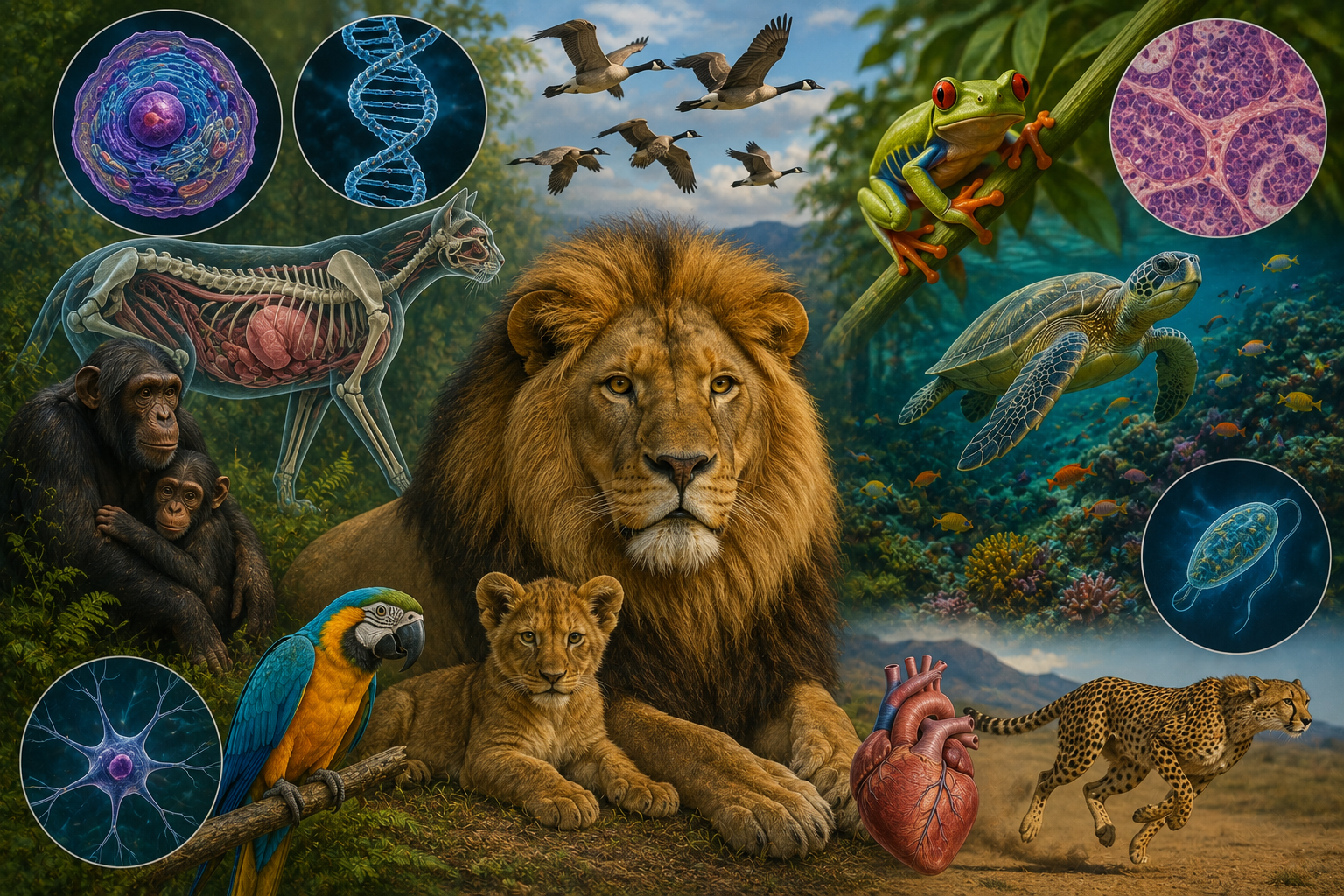
Animal Biology
Discover the incredible diversity of the animal kingdom and explore the science behind how animals are built, survive, reproduce, and interact with the world around them. From anatomy and physiology to behaviour, ecology, evolution, and adaptation, this series uncovers the remarkable biology that allows animals to thrive in every environment on Earth. Whether you're fascinated by microscopic invertebrates or the largest mammals, Animal Biology offers a comprehensive journey into the science of life.
Our Overview Courses
-
Discover the most diverse group of animals on Earth and explore the incredible adaptations that have allowed insects to colonise almost every environment imaginable. From ancient wingless lineages to butterflies, beetles, bees, and dragonflies, this series examines insect anatomy, evolution, behaviour, ecology, and the extraordinary diversity that makes Hexapoda the most successful animal group in history.
-
Journey into the fascinating world of the many-legged arthropods and discover the remarkable biology of centipedes and millipedes. Explore their evolutionary origins, anatomy, defence mechanisms, hunting strategies, and ecological importance as some of the oldest terrestrial animals on Earth.
-
From microscopic plankton to giant Japanese spider crabs, discover the astonishing diversity of the crustaceans. This series explores the evolution, anatomy, behaviour, and ecology of one of the world's most successful arthropod groups, examining how crustaceans have conquered freshwater, marine, and even terrestrial environments.
-
Explore one of the oldest and most successful groups of arthropods on the planet. Discover the extraordinary diversity of spiders, scorpions, mites, horseshoe crabs, whip spiders, camel spiders, and sea spiders while learning about their anatomy, venom, evolution, sensory adaptations, and ecological roles throughout Earth's history.
-
Beyond the arthropods lies an incredible collection of fascinating animal groups. Discover the intelligence of cephalopods, the remarkable diversity of molluscs, the unique biology of echinoderms, and the ancient simplicity of cnidarians as we explore some of the ocean's most successful and unusual inhabitants.Beyond the arthropods lies an incredible collection of fascinating animal groups. Discover the intelligence of cephalopods, the remarkable diversity of molluscs, the unique biology of echinoderms, and the ancient simplicity of cnidarians as we explore some of the ocean's most successful and unusual inhabitants.
-
Dive beneath the surface and discover the extraordinary diversity of the world's fishes, the oldest and most successful vertebrates on Earth. From the jawless lampreys that offer a glimpse into our evolutionary past to sharks, rays, and the countless species of bony fish that inhabit every ocean, river, and lake, this course explores over 500 million years of vertebrate evolution. Learn how fishes breathe, swim, hunt, communicate, reproduce, and survive in environments ranging from tropical coral reefs to the deepest ocean trenches. Along the way, uncover the remarkable adaptations, behaviours, and evolutionary innovations that have shaped the largest and most diverse group of vertebrates on the planet, while exploring their vital role in ecosystems, human society, and global conservation.
-
Discover the remarkable animals that first bridged the gap between water and land. This series explores the evolutionary history, anatomy, behaviour, physiology, and conservation of frogs, toads, salamanders, newts, and their relatives, revealing why amphibians remain some of the most sensitive indicators of environmental change.
-
Journey through more than 300 million years of reptilian evolution, from the earliest reptiles to modern snakes, lizards, crocodilians, turtles, and even the dinosaurs. Explore the anatomy, physiology, behaviour, ecology, and evolutionary relationships of one of Earth's most successful vertebrate groups, uncovering the extraordinary adaptations that have allowed reptiles to thrive across every continent.
-
Take to the skies and discover the remarkable diversity of the world's birds. From tiny hummingbirds to soaring eagles, flightless ostriches to deep-diving penguins, this series explores the evolution, anatomy, physiology, behaviour, ecology, and conservation of Aves. Learn how birds conquered the skies, evolved from their dinosaur ancestors, and adapted to thrive in almost every habitat on Earth through their extraordinary intelligence, migration, communication, and specialised lifestyles.
-
Discover the incredible diversity of mammals, from egg-laying monotremes and pouch-bearing marsupials to whales, bats, elephants, primates, and the world's great predators. Explore how mammals evolved, adapted, and diversified to become one of the planet's dominant groups of vertebrates, while examining their anatomy, behaviour, intelligence, ecology, and conservation.
-
Perfect for curious minds of all ages, this series explores the weird, wonderful, and often unbelievable world of animals. Discover incredible behaviours, bizarre adaptations, astonishing records, surprising evolutionary stories, and fascinating facts from across the animal kingdom, proving that nature is stranger, more complex, and more extraordinary than fiction.
Our Detailed Courses
-
Discover the earliest branches of the hexapods and explore the fascinating world of springtails, bristletails, and silverfish. Learn how these ancient, wingless animals evolved, examine their unique anatomy and lifestyles, and discover why these often-overlooked creatures continue to play vital roles in ecosystems around the globe.
-
Journey back to some of the first insects to take to the skies. Explore the remarkable biology of mayflies and dragonflies, from aquatic nymphs and spectacular metamorphosis to aerial hunting, migration, and one of the oldest surviving flight mechanisms in the animal kingdom.
-
Meet some of the insect world's greatest masters of camouflage, communication, and predation. Discover grasshoppers, crickets, stick insects, cockroaches, termites, mantises, and the mysterious heelwalkers while exploring their behaviour, social organisation, defence strategies, and evolutionary success.
-
Explore some of the lesser-known yet fascinating insect orders that quietly inhabit streams, forests, caves, and mountainous regions. Discover earwigs, stoneflies, webspinners, ice crawlers, and angel insects while uncovering their unique adaptations, evolutionary history, and ecological importance.
-
Discover an extraordinary group of insects that have evolved specialised mouthparts for piercing, sucking, feeding, and parasitism. Explore the remarkable diversity of true bugs, aphids, cicadas, lice, barklice, booklice, and thrips while learning about their roles as pollinators, pests, parasites, and ecosystem engineers.
-
Enter the incredible world of beetles—the largest order of animals on Earth. Discover the astonishing diversity of Coleoptera, from jewel beetles and stag beetles to weevils and ladybirds, while exploring the evolutionary innovations that have made beetles one of the most successful groups in the history of life.
-
Discover the remarkable biology of the true flies, a group that includes everything from mosquitoes and hoverflies to crane flies and robber flies. Explore their extraordinary flight abilities, complex life cycles, ecological importance, and the profound impact they have on ecosystems, agriculture, medicine, and human society.
-
Explore one of the most intelligent and socially complex groups of insects on Earth. Discover the extraordinary lives of ants, bees, wasps, and sawflies while examining eusociality, pollination, parasitism, communication, and the evolutionary innovations that have made Hymenoptera one of nature's greatest success stories.
-
Discover the colourful world of butterflies and moths and explore one of nature's most spectacular examples of complete metamorphosis. Learn about wing scales, migration, mimicry, pollination, camouflage, and the remarkable life histories that have made Lepidoptera among the most recognisable insects on Earth.
-
Complete your exploration of the holometabolous insects by discovering some of the animal kingdom's most unusual lineages. From lacewings and antlions to caddisflies, scorpionflies, snakeflies, fleas, dobsonflies, and the bizarre twisted-wing parasites, explore the extraordinary adaptations and evolutionary diversity that complete the story of Earth's most successful class of animals.
-
Discover the fast-moving predators of the myriapod world and explore the remarkable biology of centipedes. Learn how venom, specialised forcipules, incredible speed, and highly developed sensory systems have allowed these ancient arthropods to become successful hunters in habitats across the globe.
-
Explore the gentle giants of the leaf litter and discover how millipedes became some of Earth's most successful decomposers. Learn about their evolution, defensive chemistry, remarkable body segmentation, reproductive biology, and the essential role they play in recycling nutrients within ecosystems.
-
Discover some of the smallest and most unusual crustaceans on Earth. Explore the incredible diversity of seed shrimps, fish lice, tongue worms, and mysterious interstitial crustaceans while uncovering their fascinating adaptations to freshwater, marine, and parasitic lifestyles.
-
Meet the largest and most familiar crustaceans on the planet. Discover crabs, lobsters, shrimp, crayfish, krill, mantis shrimps, woodlice, and amphipods while exploring their anatomy, behaviour, communication, and the extraordinary diversity that has allowed this group to dominate aquatic ecosystems worldwide.
-
Discover how two very different groups of crustaceans have conquered both free-living and parasitic lifestyles. Explore the bizarre world of barnacles, their remarkable cement-like adhesive, and the microscopic copepods that form the foundation of many marine food webs while also including some of nature's most specialised parasites.
-
Explore one of the most important evolutionary branches within the arthropods. Discover fairy shrimps, tadpole shrimps, clam shrimps, horseshoe shrimps, enigmatic cephalocarids, cave-dwelling remipedes, and examine the evolutionary evidence suggesting that insects themselves evolved from crustacean ancestors.
-
Discover the incredible diversity of sea spiders, harvestmen, mites, and ticks. Learn how these fascinating chelicerates have adapted to marine environments, forests, deserts, and even life on other animals while exploring their unique anatomy, feeding strategies, and ecological importance.
-
Meet two of the most extraordinary survivors from the chelicerate lineage. Discover the speed and hunting abilities of camel spiders alongside the ancient horseshoe crabs, whose evolutionary history stretches back hundreds of millions of years and whose remarkable blue blood continues to play an important role in modern medicine.
-
Explore the hidden world of parasitic and predatory mites. Discover how ticks and their relatives have evolved specialised adaptations for feeding, survival, and reproduction, while learning about their ecological roles, disease transmission, and surprising diversity across terrestrial ecosystems.
-
Journey into the world of one of Earth's oldest terrestrial predators. Discover the anatomy, venom, sensory biology, courtship rituals, maternal care, and extraordinary evolutionary history of scorpions, whose ancestors first walked onto land more than 430 million years ago.
-
Meet two of the most misunderstood arachnids on the planet. Discover the remarkable whip spiders and whip scorpions, exploring their extraordinary sensory adaptations, defensive behaviours, courtship rituals, and why, despite their fearsome appearance, they pose virtually no threat to humans.
-
Discover the largest and most diverse group of spiders on Earth. Explore orb-weavers, jumping spiders, wolf spiders, crab spiders, cobweb spiders, and many more while examining silk production, venom, vision, hunting strategies, communication, and the incredible diversity that has made modern spiders successful across every continent.
-
Explore the ancient lineage of spiders that includes tarantulas, trapdoor spiders, funnel-web spiders, and purse-web spiders. Discover their powerful bodies, impressive longevity, burrowing lifestyles, and unique evolutionary adaptations that distinguish them from their more modern relatives.
-
Journey back to the earliest living branch of the spider family tree. Discover the primitive segmented spiders of Southeast Asia, exploring their ancient anatomy, evolutionary significance, and the clues they provide about the earliest origins of one of Earth's most successful groups of predators.
-
Discover one of the ocean's most unusual animal groups. Explore sea stars, brittle stars, sea urchins, sea cucumbers, and feather stars while learning about their unique five-fold symmetry, hydraulic water vascular system, extraordinary regenerative abilities, and vital role in maintaining healthy marine ecosystems.
-
Journey into one of the earliest branches of the animal kingdom and discover jellyfish, corals, sea anemones, and hydroids. Explore their remarkable stinging cells, simple yet highly effective body plans, life cycles, and the essential role that reef-building corals play in supporting some of the most biodiverse ecosystems on Earth.
-
Celebrate the incredible diversity of fishes by exploring some of the most extraordinary species and adaptations found anywhere in the animal kingdom. From electric eels and venomous stonefish to deep-sea anglerfish, Antarctic icefish, coral reef specialists, and freshwater giants, discover how evolution has produced an astonishing array of survival strategies while examining the conservation challenges facing aquatic ecosystems in the modern world.
-
Travel back over 500 million years to discover the earliest surviving vertebrates on Earth. Explore the remarkable biology of hagfish and lampreys while uncovering the origins of the vertebrate body plan, the evolution of the skull, and the extraordinary adaptations that have allowed these ancient jawless fishes to persist almost unchanged since the dawn of vertebrate life.
-
Discover one of the ocean's oldest and most successful groups of predators. From the colossal whale shark to graceful manta rays and mysterious deep-sea chimaeras, explore the biology of cartilaginous fishes while examining electroreception, specialised senses, reproduction, hunting strategies, and the evolutionary innovations that have made them masters of marine ecosystems for over 400 million years.
-
Meet the ancient survivors of the ray-finned fish lineage and discover the remarkable species that bridge the gap between prehistoric oceans and the modern world. Explore bichirs, paddlefish, sturgeons, gars, and bowfins while learning about primitive lungs, armoured scales, ancient body plans, and the evolutionary history of some of Earth's oldest living fish lineages.
-
Explore the largest and most diverse group of vertebrates on the planet. From colourful coral reef inhabitants and freshwater giants to deep-sea hunters and lightning-fast ocean predators, discover the astonishing diversity of teleost fishes while examining their anatomy, behaviour, communication, migration, reproduction, and the extraordinary adaptations that have enabled them to dominate aquatic ecosystems across the globe.
-
Uncover one of the most important chapters in the history of life on Earth. Discover the ancient coelacanths and lungfishes while exploring the remarkable evolutionary innovations that ultimately gave rise to amphibians, reptiles, birds, and mammals. Learn how fleshy fins, air breathing, and changing environments paved the way for vertebrates to conquer the land.
-
Discover one of the oldest branches of the mollusc family tree. Explore the fascinating biology of chitons and aplacophorans, learning how these armoured and shell-less animals have adapted to life on rocky shores and the deep sea while providing valuable insight into the early evolution of molluscs.
-
Explore the world's largest group of molluscs and discover the incredible diversity of snails, slugs, sea hares, nudibranchs, and sea butterflies. Learn how gastropods have evolved an astonishing variety of shells, feeding strategies, defences, and lifestyles across terrestrial, freshwater, and marine environments.
-
Discover the remarkable filter feeders and tusk shells that quietly shape aquatic ecosystems around the world. Explore the biology of clams, mussels, oysters, scallops, razor shells, and tusk shells while learning how these animals contribute to water quality, ecosystem health, and global biodiversity.
-
Meet the undisputed intellectuals of the invertebrate world. Discover octopuses, squid, cuttlefish, and nautiluses while exploring their advanced nervous systems, remarkable camouflage, problem-solving abilities, jet propulsion, and complex behaviours that rival many vertebrates.
-
Travel back over 360 million years to discover the first vertebrates that ventured onto land. Explore the origins of amphibians, the evolution of limbs, lungs, metamorphosis, and permeable skin while examining how these remarkable animals bridge the worlds of water and land and why they are among the most important indicators of environmental health.
-
Discover the incredible diversity of frogs, from tiny poison dart frogs to giant goliath frogs. Explore their anatomy, vocal communication, reproductive strategies, camouflage, hunting techniques, and astonishing adaptations that have allowed them to thrive on every continent except Antarctica.
-
Meet the resilient cousins of the frogs and discover how toads have adapted to life in a wide range of habitats. Learn about their distinctive skin, powerful toxins, breeding behaviour, ecological importance, and the remarkable survival strategies that make them some of the world's most successful amphibians.
-
Explore the secretive world of salamanders, newts, and the extraordinary axolotl. Discover their remarkable regenerative abilities, aquatic and terrestrial lifestyles, courtship displays, and evolutionary history while examining why these fascinating amphibians are among the most scientifically important vertebrates alive today.
-
Journey through more than 250 million years of reptile evolution and discover how lepidosaurs became one of the most successful groups of vertebrates on Earth. Explore the origins of lizards, snakes, tuataras, and amphisbaenians while examining the anatomical innovations, adaptations, and evolutionary relationships that have allowed this remarkable lineage to thrive across almost every terrestrial habitat.
-
Discover the colourful and charismatic world of the iguanas. From the giant Green Iguana of South America to the marine iguanas of the Galápagos, explore the anatomy, behaviour, herbivorous lifestyles, social communication, and evolutionary adaptations that define one of the most recognisable families of lizards.
-
Meet the dragons of the reptile world. Discover bearded dragons, frilled lizards, sailfin dragons, and dozens of remarkable agamids while exploring territorial behaviour, visual communication, thermal regulation, and the extraordinary adaptations that allow these reptiles to thrive across Africa, Asia, Australia, and Europe.
-
Step into the extraordinary world of chameleons and uncover the science behind one of nature's most iconic reptiles. Explore independently moving eyes, ballistic tongues, specialised feet, colour change, camouflage, communication, and the evolutionary pressures that have produced these remarkable masters of the trees.
-
Discover the remarkable diversity of geckos, one of the most successful groups of lizards on the planet. Learn how microscopic toe pads allow them to climb smooth surfaces, explore their unique vocalisations, nocturnal lifestyles, regenerative abilities, and the extraordinary adaptations that have enabled geckos to colonise habitats around the globe.
-
Meet one of the most diverse reptile lineages, ranging from slow worms and glass lizards to monitor lizards, Gila monsters, and Komodo dragons. Explore the evolution of venom, intelligence, sensory adaptations, predatory behaviour, and the evolutionary innovations that have made anguimorphs some of the most formidable reptiles alive today.
-
Explore the world's largest snake family and discover the astonishing diversity of the colubrids. From harmless grass snakes and kingsnakes to racers, rat snakes, and boomslangs, examine their anatomy, feeding ecology, defensive strategies, and the evolutionary success that has allowed this family to occupy almost every terrestrial ecosystem on Earth.
-
Discover the powerful constrictors that include boas, anacondas, and sand boas. Learn how these ancient snakes hunt without venom, explore their remarkable sensory systems, reproductive biology, aquatic and terrestrial lifestyles, and the evolutionary history of some of the world's largest living reptiles.
-
Journey into the world of the pythons, a family of giant constrictors found throughout Africa, Asia, and Australia. Explore their powerful musculature, heat-sensing pits, maternal care, hunting behaviour, and the fascinating evolutionary adaptations that distinguish them from their close relatives, the boas.
-
Meet some of the most highly specialised venomous snakes on Earth. Discover cobras, mambas, coral snakes, kraits, taipans, sea snakes, and death adders while exploring venom evolution, neurotoxins, defensive displays, marine adaptations, and the ecological importance of one of the world's most medically significant snake families.
-
Dive into the oceans of the Mesozoic Era and discover the remarkable reptiles that evolved to become masters of the sea. Explore the evolution of ichthyosaurs and their relatives, learning how streamlined bodies, enormous eyes, live birth, and powerful swimming adaptations allowed them to dominate prehistoric oceans for over 150 million years before their eventual extinction.
-
Travel back over 230 million years to uncover the remarkable story of the crocodilian lineage. Discover how small, agile terrestrial ancestors evolved into the formidable semi-aquatic predators we know today, while exploring the evolutionary history, anatomy, behaviour, and adaptations that have allowed crocodilians to survive virtually unchanged since the age of the dinosaurs.
-
Meet the quieter cousins of the crocodiles and explore the fascinating world of alligators and caimans. Learn how these powerful reptiles have adapted to freshwater environments, examine their remarkable parental care, hunting strategies, communication, and discover the unique features that distinguish them from the rest of the crocodilian family.
-
Discover the world's largest living reptiles and explore the biology of nature's ultimate ambush predators. From the Nile Crocodile to the mighty Saltwater Crocodile, learn about their immense bite force, sophisticated hunting techniques, complex social behaviours, and extraordinary evolutionary success across tropical ecosystems.
-
Explore one of the most distinctive body plans in the animal kingdom and discover how turtles evolved their iconic shells. Journey through more than 220 million years of evolution while examining shell development, anatomy, physiology, and the ongoing scientific debate surrounding the evolutionary origins of these remarkable reptiles.
-
Dive into the world of freshwater and marine turtles and discover how these reptiles have conquered rivers, lakes, oceans, and wetlands around the globe. Explore migration, navigation, feeding ecology, nesting behaviour, and the incredible adaptations that enable sea turtles to undertake some of the longest migrations in the animal kingdom.
-
Meet the gentle giants of the reptile world and discover how tortoises have become masters of life on land. Explore their anatomy, longevity, herbivorous lifestyles, island evolution, and conservation while learning why some species rank among the longest-lived vertebrates on Earth.
-
Meet the horned giants of the Late Cretaceous and discover how Ceratopsians evolved into some of the most spectacular herbivores to ever walk the Earth. From Psittacosaurus to Triceratops, explore horns, frills, herd behaviour, defence strategies, and the evolutionary arms race with large theropod predators.
-
Discover one of the earliest and most unusual groups of ornithischian dinosaurs. Explore the fascinating heterodontosaurs, whose varied teeth, agile bodies, and possible omnivorous lifestyles challenge traditional ideas about early dinosaur evolution and reveal the experimental nature of the earliest herbivorous dinosaurs.
-
Explore the remarkable success of the ornithopods, from small, fleet-footed grazers to the giant duck-billed hadrosaurs. Discover their sophisticated chewing mechanisms, social behaviour, nesting colonies, vocal communication, and the adaptations that made them some of the most abundant herbivores of the Mesozoic Era.
-
Meet the dome-headed dinosaurs and investigate one of palaeontology's greatest debates. Explore the anatomy, behaviour, and evolution of pachycephalosaurs while examining the evidence for head-butting, display structures, and the social behaviours that may have shaped these distinctive herbivores.
-
Discover the living tanks of the dinosaur world. Explore the evolution of armour, tail clubs, defensive strategies, and feeding ecology while learning how ankylosaurs became some of the most heavily protected animals ever to evolve.
-
Meet the iconic plated dinosaurs and uncover the secrets behind one of prehistory's most recognisable body plans. Explore the function of plates and tail spikes, feeding behaviour, growth, and the evolutionary adaptations that allowed stegosaurs to thrive during the Jurassic Period.
-
Travel to the dawn of the Dinosauria and discover the earliest saurischians that gave rise to both the giant sauropods and fearsome theropods. Explore their origins, anatomy, evolutionary relationships, and the environmental changes that allowed dinosaurs to become the dominant terrestrial vertebrates.
-
Stand alongside the largest animals ever to walk the Earth. Discover the biology of Diplodocus, Brachiosaurus, Argentinosaurus, and their relatives while exploring gigantism, long-neck evolution, respiration, growth, biomechanics, and the ecological role of these colossal herbivores.
-
Meet the predators that ruled the Mesozoic and ultimately gave rise to modern birds. Explore the extraordinary diversity of theropods, from agile hunters like Velociraptor to the mighty Tyrannosaurus rex, while examining feathers, intelligence, pack behaviour, biomechanics, and the evolutionary journey that transformed terrestrial predators into the birds that fill our skies today.
-
Discover the oldest living lineage of birds and explore the remarkable diversity of ratites and tinamous. From the towering ostriches of Africa to the elusive kiwis of New Zealand, learn how these ancient birds evolved, why many lost the ability to fly, and what they reveal about the origins of modern birds.
-
Meet the earliest branch of modern birds and discover the fascinating biology of ducks, geese, swans, pheasants, quail, grouse, and turkeys. Explore courtship, migration, domestication, parental care, and the evolutionary adaptations that have made these birds successful across a wide range of habitats.
-
Explore the oceans, rivers, wetlands, and coastlines of the world through the lives of pelicans, flamingos, herons, penguins, gulls, albatrosses, puffins, cormorants, and many more. Discover how these birds have evolved remarkable adaptations for swimming, diving, migration, and life on the open sea.
-
Meet the masters of the skies and the silent hunters of the night. Discover eagles, hawks, falcons, vultures, owls, secretary birds, and other specialised predators while exploring exceptional eyesight, silent flight, powerful talons, hunting strategies, and the evolutionary arms race between predator and prey.
-
Journey through forests, deserts, rainforests, and mountains to discover the incredible diversity of non-passerine land birds. Explore parrots, hornbills, toucans, cuckoos, kingfishers, bee-eaters, woodpeckers, hummingbirds, swifts, and many more while uncovering their extraordinary adaptations, behaviours, and ecological roles.
-
Discover the largest and most successful group of birds on Earth. From crows and ravens to robins, finches, warblers, birds-of-paradise, and lyrebirds, explore the evolution of song, intelligence, migration, social behaviour, and the remarkable adaptations that have allowed passerines to colonise every continent.
-
Meet the most ancient living mammals and discover the extraordinary monotremes of Australia and New Guinea. Explore the biology of platypuses and echidnas while learning how egg-laying, electroreception, venom, and other primitive characteristics provide a fascinating glimpse into the earliest stages of mammalian evolution.
-
Discover the remarkable mammals that complete much of their development inside a pouch. From kangaroos and koalas to wombats, quolls, Tasmanian devils, and opossums, explore the evolution, reproduction, ecology, and incredible diversity of one of the world's most distinctive mammalian lineages.
-
Explore the only mammals capable of true powered flight and discover the astonishing diversity of bats. Learn how echolocation, specialised wings, social behaviour, pollination, seed dispersal, and insect control have made bats one of the most ecologically important groups of mammals on Earth.
-
Meet the largest order of mammals and discover the extraordinary success of rodents. Explore squirrels, mice, rats, porcupines, beavers, guinea pigs, capybaras, and many more while learning about their anatomy, intelligence, ecological importance, and remarkable adaptability.
-
Discover the close relatives of rodents and explore the fascinating biology of rabbits, hares, and pikas. Learn about their specialised digestive systems, incredible reproductive strategies, communication, predator avoidance, and their importance within ecosystems around the world.
-
Explore one of the oldest surviving groups of placental mammals. Discover the secretive lives of hedgehogs, moles, shrews, and moonrats while examining their remarkable sensory adaptations, underground lifestyles, high metabolic rates, and the evolutionary history of these small but highly successful mammals.
-
Uncover one of the most surprising branches of the mammal family tree. Explore how elephants, tiny hyraxes, and the gentle dugongs and manatees are closely related through evolution while examining their anatomy, behaviour, conservation, and the shared ancestry that links these seemingly unrelated animals.
-
Journey through the evolution of the mammals that ultimately gave rise to humans. Discover lemurs, monkeys, apes, colugos, and treeshrews while exploring intelligence, social behaviour, tool use, communication, and the evolutionary innovations that have shaped one of the planet's most fascinating animal groups.
-
Meet the world's only scaly mammals and uncover the extraordinary adaptations of pangolins. Explore their unique armour, specialised diets, powerful claws, evolutionary history, and the conservation challenges facing one of the most heavily trafficked groups of mammals on Earth.
-
Discover the stealthy hunters of the mammalian world. From lions and tigers to hyenas, civets, mongooses, and fossas, explore the evolution, anatomy, behaviour, communication, and predatory adaptations that define the cat-like carnivores.
-
Meet the diverse relatives of dogs, including wolves, foxes, bears, raccoons, mustelids, seals, sea lions, walruses, and red pandas. Discover how this incredibly varied group has evolved to occupy habitats ranging from Arctic ice to tropical forests and the open oceans.
-
Explore the evolution of horses, zebras, donkeys, rhinoceroses, and tapirs while discovering how odd-toed ungulates became some of the world's most iconic herbivores. Learn about their specialised limbs, digestive systems, social structures, and their changing relationship with humans throughout history.
-
Discover the extraordinary diversity of even-toed hoofed mammals, including pigs, peccaries, camels, llamas, deer, antelope, giraffes, cattle, sheep, goats, hippos, and many more. Explore rumination, specialised digestive systems, horn evolution, migration, and the ecological importance of one of the most successful mammalian radiations.
-
Complete your journey through the Mammalia by exploring one of evolution's greatest transformations. Discover how ancient terrestrial hoofed mammals returned to the sea to become whales, dolphins, and porpoises, while examining echolocation, deep diving, complex communication, intelligence, social behaviour, and the extraordinary adaptations that have allowed cetaceans to become the giants of the modern oceans.
Design Your Course!
Learn Your Way!
Individual Sessions
Perfect for exploring a new topic without committing to a full course.
Our Individual Sessions are designed for learners who want to discover a specific area of biology in a single, engaging lesson. Each one-hour session focuses on a fascinating topic, combining expert knowledge, real-world examples, and captivating stories from the natural world. Whether you're trying Academy WC for the first time or simply have a passion for one particular subject, these sessions offer an enjoyable and flexible way to learn at your own pace.
Charge - £45 (Live Lessons With Your Online Expert) or £15 (Pre-Recorded Lessons)
Beginner Courses
Perfect for complete beginners, curious minds, and anyone looking to build confidence in biology.
Our Beginner Courses assume no previous scientific knowledge. We start with the fundamentals, introducing key concepts in an engaging, jargon-free way through stories, demonstrations, real-world examples, and fascinating animals. Whether you're a home-educated learner, a family discovering science together, or an adult returning to education, these courses provide the perfect foundation for exploring the natural world.
Charge - £120 (Live Lessons With Your Online Expert) or £50 (Pre-Recorded Lessons)
Intermediate Courses
Ideal for learners who already understand the basics and are ready to explore biology in greater depth.
Intermediate Courses build upon existing knowledge by introducing more detailed scientific concepts, evolutionary theory, ecology, anatomy, behaviour, and conservation. Learners are encouraged to think critically, make connections between different biological disciplines, and develop a deeper appreciation of how life on Earth is interconnected. These sessions are well suited to enthusiastic hobbyists, older students, and anyone wanting to move beyond introductory biology.
Charge - £150 (Live Lessons With Your Online Expert) or £60 (Pre-Recorded Lessons)
Advanced Courses
Designed for passionate learners seeking college-level or university-level scientific discussion in an accessible environment.
Our Advanced Courses delve into specialist topics using current scientific understanding, evolutionary principles, primary research, and detailed biological theory. Complex ideas are presented clearly without sacrificing scientific accuracy, making these sessions suitable for aspiring biologists, university students, educators, professionals, and lifelong learners. Expect challenging discussions, thought-provoking questions, and a deeper exploration of the remarkable science that shapes our understanding of life on Earth.
Charge - £190 (Live Lessons With Your Online Expert) or £70 (Pre-Recorded Lessons)
Get In Touch
If you're interested in working with us, complete the form with a few details about your project. We'll review your message and get back to you within 48 hours.